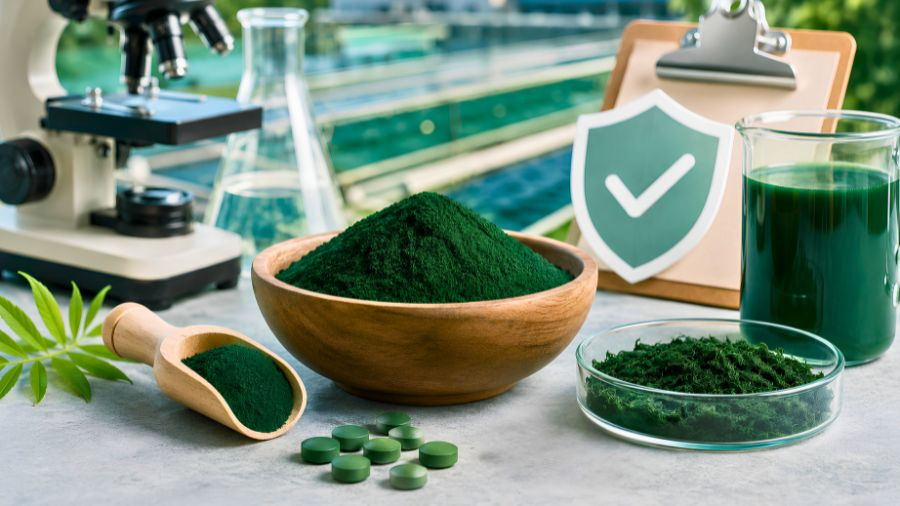
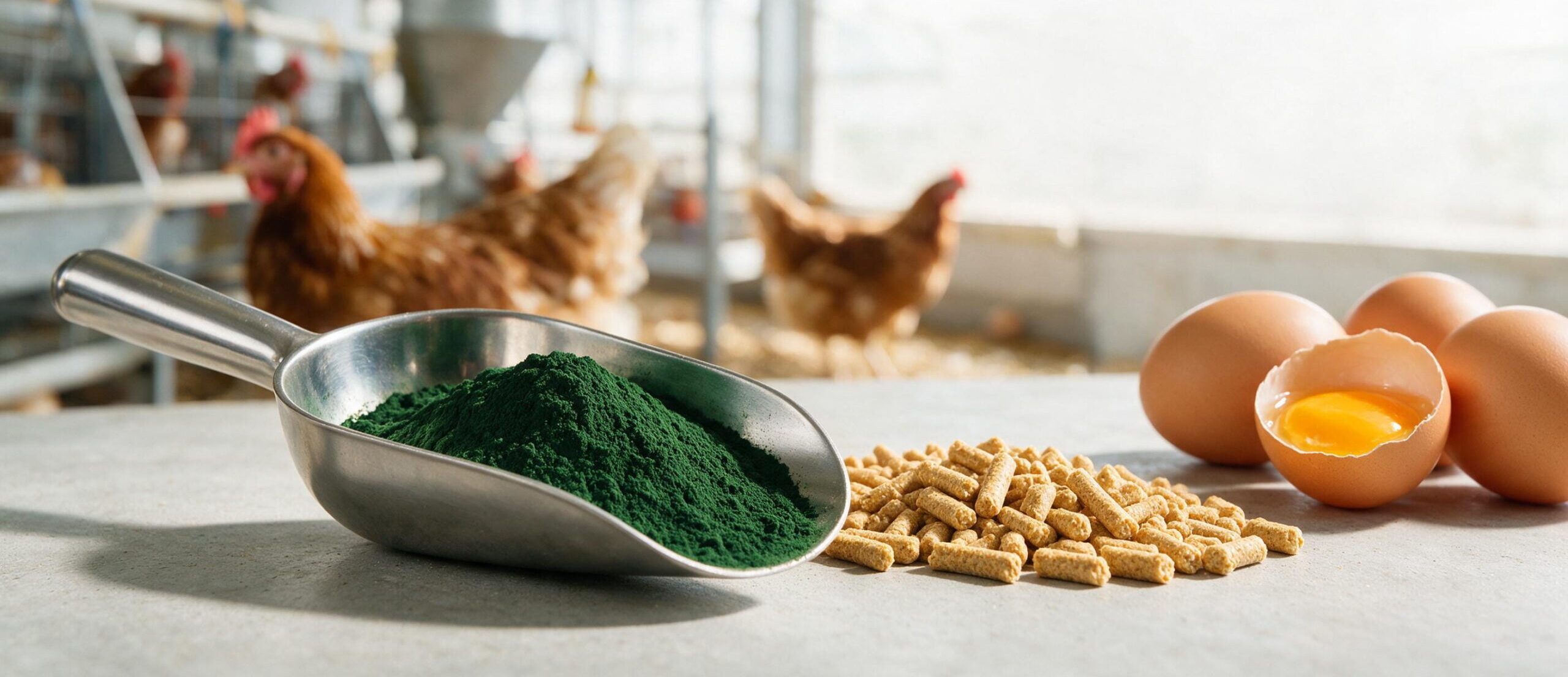
Spirulina is emerging as one of the most versatile natural feed additives in modern poultry nutrition, valued not just for its protein but for its functional bioactive profile and visible impact on product quality.
As a feed grade spirulina ingredient and algae feed supplement, it is increasingly used by poultry feed manufacturers and feed mills across India to support better feed efficiency, natural yolk pigment deposition, and cleaner formulations for broilers, layers, breeders, livestock nutrition and aquaculture feed programmes.
Why spirulina works as a functional poultry feed additive
Spirulina (Arthrospira platensis) is a microalga containing roughly 60–70% protein by dry weight, plus essential amino acids, vitamins, minerals, and unique compounds such as phycocyanin and carotenoids.
These carotenoids—particularly β‑carotene and zeaxanthin—act as natural pigments and antioxidants, supporting deeper egg yolk colour, oxidative stability and overall bird resilience when spirulina is used as a poultry feed additive at appropriate inclusion levels.
Because of this functional profile, spirulina is best positioned as a natural feed additive and animal feed ingredient that supports performance, health and product quality, rather than a simple protein replacer in poultry nutrition.
Functional inclusion ranges in commercial diets
In practice, spirulina is applied at graded inclusion ranges depending on objectives, with lower levels used as a functional additive and higher levels sometimes explored for more aggressive performance or pigmentation goals.
Commercial use commonly starts from around 2–5 g/kg (0.2–0.5%) of feed, where spirulina acts as a functional additive that supports gut health, antioxidant status and production consistency in broiler feed supplement and layer feed supplement programmes.
For targeted performance enhancement, some trials have used higher inclusion bands (for example 5–10 g/kg) under properly formulated diets to explore stronger effects on feed conversion ratio (FCR), immune function and resilience, especially in challenged birds.
Spirulina and FCR: what the data show
Multiple studies have evaluated spirulina as a bioactive feed grade spirulina supplement in broiler diets and have shown that it can support improved feed conversion ratio (FCR) when diets are correctly balanced.
For instance, broiler trials with 5 g spirulina/kg diet reported increased body‑weight gain and better gain‑to‑feed ratios, indicating that spirulina may improve FCR under properly formulated diets and supportive management conditions.
Other work with 0.3–0.5% spirulina in broiler rations found higher body‑weight gains and better FCR compared with controls, again highlighting spirulina’s role as a complementary broiler feed supplement rather than a standalone solution.
Egg yolk colour and natural yolk pigment
One of the most visible benefits of spirulina in layer feed supplement programmes is its effect on egg yolk colour via natural carotenoid deposition.
Spirulina’s high levels of zeaxanthin, xanthophylls and β‑carotene act as natural yolk pigment sources, and studies using 0.2% spirulina in layer diets have reported significantly higher yolk colour scores and enhanced carotene deposition compared with unsupplemented controls.
While stronger pigmentation has been observed at higher inclusion levels (2–2.5%), several studies have shown measurable improvements in yolk colour even at practical commercial inclusion rates around 2–3 g/kg, making spirulina a realistic algae feed supplement for cost‑sensitive layer operations.
Spirulina across broilers, layers and breeders
Research has evaluated spirulina in broilers, commercial layers and breeder birds, focusing on growth, egg production, FCR, immune response, gut health and carcass or egg quality.
In broilers, spirulina has been shown to support better early growth, improved antioxidant capacity, stronger gut morphology and resilience under coccidial challenge when used as a functional feed additive alongside existing coccidiosis‑control strategies.
In layers and breeders, studies report higher hen‑day egg production, improved egg weight and mass, and better yolk colour scores, all of which are important economic and quality drivers for poultry feed manufacturers and integrators.
Integrating spirulina in Indian feed mill formulations
For Indian feed mills and poultry feed manufacturers, spirulina can be integrated as either pure feed grade spirulina powder within existing premix systems or as stage‑specific spirulina‑fortified pellets designed for broiler, layer and breeder birds.
At functional inclusion levels (2–5 g/kg), spirulina is added on top of standard broiler or layer formulations to act as a natural feed additive without disturbing the core energy and amino acid matrix of the compound feed.
Where flocks or markets demand more intense natural yolk pigment or stronger performance differentiation, higher inclusion bands are trialled under technical supervision, allowing poultry nutrition teams to quantify return on investment via FCR, egg mass and pigmentation metrics.
Role in wider livestock and aquaculture feed
Although this article focuses on poultry nutrition, spirulina is also widely explored as a functional ingredient in livestock nutrition and aquaculture feed, including fish and shrimp diets where palatability, survival and flesh coloration are critical.
Trials in aquaculture systems show that spirulina can act as a premium algae feed supplement supporting better feed response, survival consistency and natural pigmentation, reinforcing its role as a versatile animal feed ingredient across multiple species.
For integrated businesses managing poultry, ruminant and aquaculture portfolios, working with a single reliable spirulina supplier simplifies quality control and feed mill operations across all downstream feed lines.
Spirulina feed FAQ
How much spirulina should be added to poultry feed?
Commercial inclusion commonly ranges from 2–5 g/kg, depending on production objectives, bird type and overall formulation strategy.
As a guideline: functional additive use often sits around 2–5 g/kg (0.2–0.5%), performance enhancement trials may explore 5–10 g/kg, and pigmentation‑focused programmes sometimes use higher levels (10–20 g/kg) to produce stronger yolk colour when supported by balanced diets.
Does spirulina improve egg yolk colour?
Yes. Spirulina naturally contains carotenoids such as β‑carotene and zeaxanthin that support deeper yolk pigmentation by increasing carotenoid deposition in the yolk.
Studies with spirulina supplementation in layer diets have consistently reported higher yolk colour scores and more intense natural yolk pigment compared with control diets, confirming its value as a natural feed additive for egg quality.
Can spirulina replace soybean meal?
No. Spirulina is generally used as a functional feed additive, not a complete protein replacement for bulk ingredients like soybean meal.
It complements existing protein sources by providing concentrated bioactives and natural pigments, helping improve performance and egg or meat quality under properly formulated diets rather than serving as a primary protein base.
Is spirulina suitable for broilers and layers?
Yes. Research has evaluated spirulina in broilers, commercial layers and breeder birds, with impacts reported on growth performance, FCR, immunity, gut health and egg quality.
When applied at appropriate inclusion rates and supported by sound poultry nutrition practice, spirulina can be a useful broiler feed supplement and layer feed supplement for both conventional and antibiotic‑reduced programmes.
Working with a spirulina poultry feed India supplier
Because spirulina is a biological ingredient, consistent quality, safety and technical support are critical when selecting a spirulina poultry feed India supplier for long‑term programmes.
Nutrialgo supplies consistent feed grade spirulina with batch‑wise COA, contaminant testing, traceability, technical guidance and stage‑specific poultry feed formulations to help feed manufacturers maintain consistent product performance.
Nutrialgo partners with poultry feed manufacturers, feed mills and integrators across India, supplying documented spirulina solutions for broiler, layer and breeder flocks as well as spirulina‑based aquaculture feed and livestock nutrition lines.
Bringing spirulina into your poultry programme
Whether your objective is improved feed efficiency, natural yolk pigmentation, or cleaner feed formulations, spirulina can be an effective functional ingredient when used at the correct inclusion rate under properly formulated diets.
Working with a manufacturer that provides consistent quality, batch‑wise COAs, contaminant testing, and technical support is essential for achieving reliable results in commercial poultry nutrition and allied animal feed ingredients.
Nutrialgo partners with feed mills, integrators, and poultry producers across India with certified feed grade spirulina and application guidance for broiler, layer, and breeder programmes, making it easier to translate research findings on FCR and natural yolk pigment into predictable field performance.