
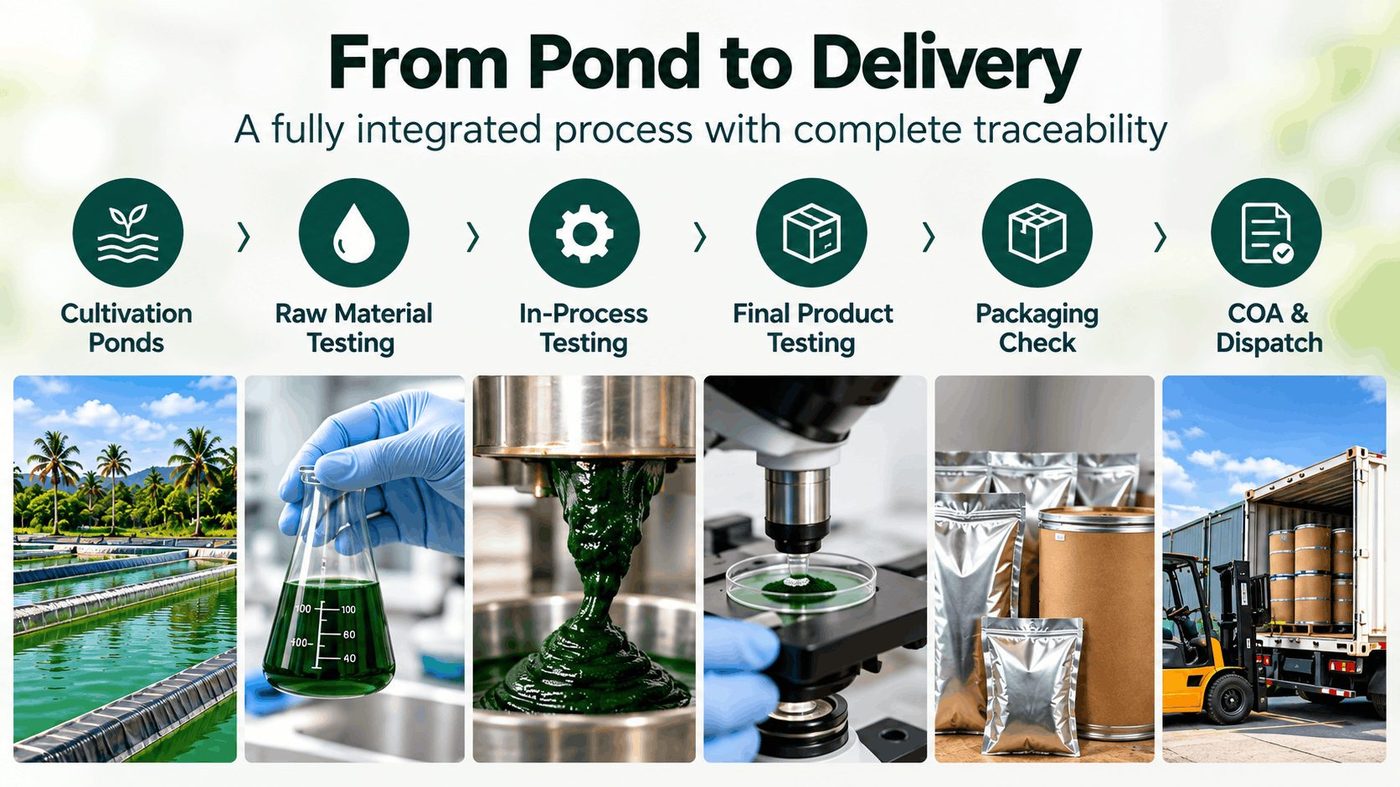
Spirulina is a “superfood” celebrated for its high protein, pigment, and nutrient content, but its value depends on rigorous supply-chain transparency. In food production, traceability means recording each step from raw ingredient to finished product. For consumers and B2B buyers alike, knowing exactly where a supplement ingredient comes from is now essential for safety, quality, and marketing. As one industry review notes, “the importance of traceability has grown due to consumers’ increasing attention to food safety and food quality, and due to the increasing complexity of food supply chains”.
Brands and regulators are responding by demanding documented chains of custody. For example, Nutrialgo emphasizes that every batch of spirulina comes with a Certificate of Analysis (COA) generated in-house, enabling “thousands” of data points on origin, composition, and purity to be traced and audited. This allows ingredient buyers to confidently label products (e.g. “Tamil Nadu-sourced spirulina”) with verified provenance.
Why Traceability Matters for Spirulina
- Safety and Recalls: In food processing, traceability systems (using barcodes/RFID tags) let producers pinpoint exactly which lots are affected in a contamination or recall. This minimizes waste and risk. A linked analysis explains that with good trace data, companies can “identify, by precise date/time and exact location which goods must be recalled, and which are safe”. For spirulina, rigorous testing for pathogens, toxins, and contaminants at each stage (cultivation, harvest, processing) is common to uphold safety standards.
- Consumer Trust and Marketing: Modern consumers prize transparency. Studies show demand for organic, sustainable, and traceable supplements is rising sharply. For instance, European markets now emphasize “traceable microalgae cultivation and controlled production environments” to satisfy clean-label requirements. In practice, brands of foods and cosmetics want to answer questions like “Where exactly does this spirulina come from?”. As Nutrialgo’s founder notes, buyers want to link a product’s label all the way back to a specific farm, pond and batch – effectively turning traceability into a brand story.
- Regulatory Compliance: International standards back up traceability. The ISO 22005:2007 standard, for example, sets global principles for feed/food chain traceability, ensuring firms can track a product’s history or location on demand. In the EU, updated organic regulations now require precise origin labeling – e.g. declaring “EU/non-EU Agriculture” or specific country names when inputs come from multiple sources. Without robust trace data, compliance is impossible.
- Supply-Chain Efficiency: Traceability isn’t just risk management; it helps identify inefficiencies. Knowing exactly how ingredients flow enables better quality control and planning. For instance, internal batch logs (pond number, harvest date, etc.) allow growers to compare yield or quality across ponds and seasons. Companies that invest in traceability can reduce “hidden costs behind low-price spirulina” caused by audit failures and batch inconsistencies.
Industry Trends and Standards
- Premiumization & Organic Demand: Market research shows spirulina is transitioning from a commodity to a premium ingredient. Buyers increasingly seek organic certifications, clean-label processing, and eco-friendly packaging. Persistence Market Research projects 9.6% CAGR for organic spirulina extracts, driven by consumer values in purity and sustainability. In supplements and foods, product developers are “integrating organic spirulina” into new offerings and emphasizing traceability to justify higher prices.
- Global Supply Risks: Many spirulina suppliers have opaque supply chains, especially in fragmented markets. Undocumented or cheap imports can expose brands to regulatory audits and recalls. Analysts warn: “Chasing the cheapest option leads to variable quality… Trusting labels without certification can backfire in audits”. In contrast, certified suppliers (with ISO, Organic, etc.) mitigate these risks. Nutrialgo highlights that customers consolidate purchasing with “single documented partners” to avoid those hidden costs.
- Technology & Trace Tech: Emerging tools like blockchain and digital farming are enabling new trace systems. Large food suppliers now use blockchain apps to create immutable records of origin and handling. On the farm side, tech innovations (automated ponds, IoT sensors, AI monitors) let cultivators maintain consistent water and nutrient conditions. These tools reduce human error in tracking and can be an eventual upgrade for high-precision spirulina farms.
Best Practices for Traceable Spirulina Supply Chains
- Single-Site Control: An ideal traceable spirulina supply starts and ends at one controlled facility. When all cultivation, drying, testing and packaging happen under one roof, “traceability is not a software layer added on top; it is the natural result of never letting the batch leave the building”. This avoids fragmentation (e.g. outsourcing to co-packers) and ensures full custody from pond to pallet.
- Batch Coding & Records: Assign a unique batch number to every harvest. Keep detailed logs linking that batch to its source pond and date. For example, Nutrialgo’s system ties each batch to a pond number (“Cultivation logs tie each batch to its pond and cycle”) and includes that batch code on every shipping unit. This lets anyone audit the ingredient back to its exact pond. It also means every output lot “ships with a Certificate of Analysis” verified by an in-house lab.
- In-House Testing and Documentation: Test every batch in-house at multiple stages. Maintaining an internal lab for routine checks (protein content, pigment levels, microbial counts, heavy metals, etc.) guarantees data is available to clients. Suppliers should publish their specifications (e.g. nutrition and purity ranges) and provide sample COAs to prospective buyers. As Nutrialgo notes, good suppliers will “screen in our in-house laboratory for composition, pigments, and microbial safety” and ensure “a COA on every batch”.
- Certifications and Training: Maintain recognized certifications (e.g. FSSAI, ISO 22000, GMP, Organic, Halal) and put certificate copies in a central library for customers. Conduct regular internal audits and train staff on record-keeping. Many companies also implement ISO 22005 traceability systems to align with best practices. The act of going through certifications bolsters traceability and creates documentation buyers can check (e.g. COAs, audit reports).
- Digital Tracking: Utilize barcodes or QR codes on bags and containers to encode batch data (origin, date, COA link). Advanced farms may use blockchain or cloud databases so that every transaction — from filling a drying tray to dispatching a pallet — automatically appends to the batch record. Even simple ERP or spreadsheet systems can centralize this data if diligently updated.
- Transparency with Buyers: Finally, the most traceable companies treat origin information as a marketing asset. Nutrialgo’s marketing story shows how firms can turn trace data into brand storytelling: they helped a client market “Tamil Nadu–sourced spirulina” on their label because Nutrialgo could prove the pond and farm for each batch. In a B2B setting, encourage clients to ask for full traceability and offer them audit-support documents (lab reports, farm photos, etc.) to differentiate their end products.
Nutrialgo’s Traceability Model
Nutrialgo exemplifies these best practices. It proudly calls itself “The documented microalgae company,” because it built operations around full transparency. Key points from Nutrialgo’s approach include:
- Single-Facility Cultivation: The company grows, harvests, processes, tests, and packages all spirulina on one site in Tamil Nadu. This ensures “zero gaps” in custody: plants never leave Nutrialgo’s control.
- Full Batch History: Each batch is logged at five stages (cultivate, harvest, process, test, pack/dispatch) with detailed records linking it to its original pond. For instance, harvest logs explicitly “link biomass to its source pond and date” so the pond-of-origin is never in doubt. Even the branded bulk bags carry coding that ties back to that original farm.
- In-House Lab & COAs: Nutrialgo tests every batch internally for composition, pigment (phycocyanin), and microbial safety, and attaches a COA to each shipment. They emphasize “100% of batches ship with a Certificate of Analysis” produced by their lab. This rigorous testing underpins traceability, because the COA also verifies the ingredient’s compliance to buyer specifications.
- Certifications and Published Specs: Nutrialgo holds FSSAI, ISO 9001, GMP, and Halal certifications, and is pursuing Organic and Kosher. They publish full nutritional and purity specs for their spirulina powder so buyers know exactly what ranges to expect. Every copy of their spec sheet and sample COA is readily available on request.
- Marketing the Origin Story: Nutrialgo actively helps clients leverage traceability in their branding. A LinkedIn case study recounts how a Chennai food brand was able to advertise “Tamil Nadu–sourced spirulina” because Nutrialgo could prove each pond, batch, and COA. As one post explains, by adding “pond-source identifiers alongside analytical results,” Nutrialgo lets customers honestly claim “This is where our spirulina comes from”. This approach not only meets buyer QA needs, but creates a genuine brand story around ingredient provenance.