
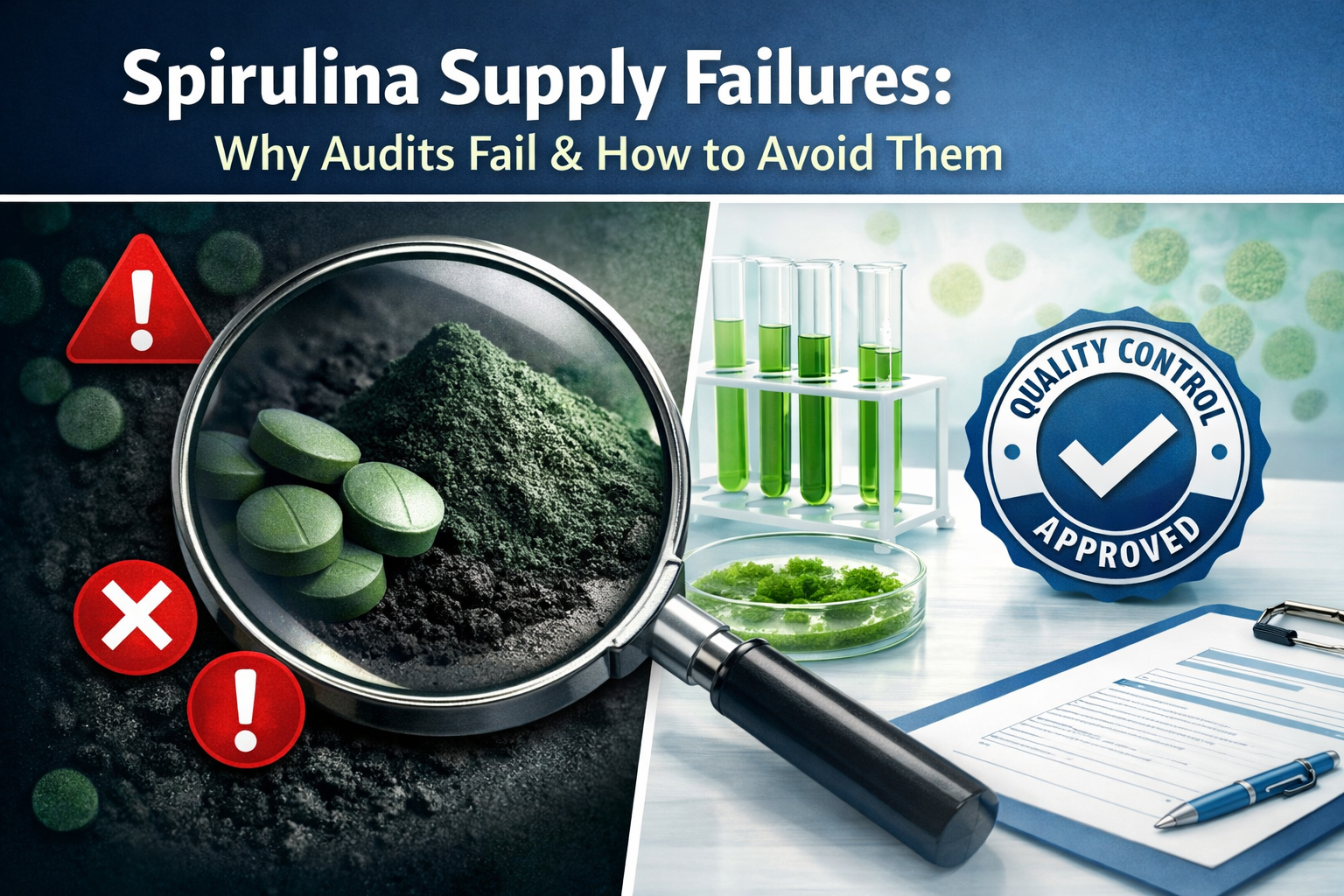
Every year, brands discover the hard truth too late: their spirulina products failed basic quality testing. Entire shipments rejected. Costly recalls. Damaged relationships with retailers. The problem isn’t always a bad supplier—it’s a broken audit process. In the rapidly growing wellness industry, B2B nutrition buyers often inherit supply chain vulnerabilities from previous sourcing decisions, and audits designed to catch contamination frequently miss it. This article examines why audit processes fail in spirulina sourcing and outlines practical strategies to audit-proof your supply chain, preventing costly failures from occurring.
The Scale of the Problem: Why 30% of Imported Spirulina Fails Testing
Third-party testing laboratories report alarming failure rates across imported spirulina batches. Data from major testing facilities indicate that approximately 30% of imported spirulina fails basic safety standards, including tests for heavy metals, microbial contamination, and cyanotoxin presence. When brands source from undocumented suppliers without verifying certifications, this risk multiplies.
Heavy metal contamination represents the most common failure point. Between 2019 and 2024, ConsumerLab and independent testing organizations found that more than one-third of commercial spirulina products exceeded California Prop 65 limits for lead. In some cases, samples from a single manufacturer varied wildly in quality from batch to batch, suggesting inconsistent process controls. The consequences extend beyond regulatory penalties: a single contaminated shipment can cost brands $50,000 to $500,000 in recall expenses, legal liability, and lost shelf space. Yet many companies discover contamination only after products reach retail shelves or during routine regulatory audits—far too late to prevent damage.
The root cause of these failures isn’t always visible in standard audit checklists. Suppliers may hold valid certifications and pass visual facility inspections while their actual production processes remain vulnerable to contamination at hidden points in the supply chain.
Three Red Flags That Audits Commonly Miss
Red Flag 1: Inadequate Testing Protocol Documentation
Audits often verify that suppliers perform testing, but rarely validate whether the testing is actually comprehensive. Many suppliers claim to test for heavy metals and microbial contaminants, but audits typically accept a Certificate of Analysis without verifying the scope or accuracy of that testing.
A critical oversight: suppliers may test finished products but not test incoming water sources, cultivation media, or harvesting equipment—all major contamination vectors. Open pond systems are particularly vulnerable. Water evaporation from raceway ponds can concentrate contaminants naturally present in local water supplies. If water quality isn’t monitored at the cultivation stage, heavy metals and microbial organisms will accumulate in the final product.
Audit teams should require suppliers to document testing for each critical control point, not just the final product. Request third-party test reports from ISO-certified laboratories (not internal testing alone) and verify that testing includes phycocyanin assay, microcystin screening, heavy metal analysis (lead, cadmium, arsenic, mercury), and bacterial colony counts at aerobic and anaerobic levels.
Red Flag 2: Missing Traceability Records and Batch Control
Traceability failures create blind spots in supply chain visibility. Many audits confirm that suppliers can trace products to “harvest season” or “supplier region,” but fail to require batch-level traceability with linked testing documentation.
When contamination occurs, brands without granular batch records cannot isolate the problem. A supplier may ship 50 batches per year from the same facility, and if only three batches are contaminated but the audit documentation lumps all batches together, you risk accepting a contaminated batch without detection. The new FSMA Rule 204 (effective January 2026) mandates digital traceability for high-risk foods within 24 hours. Spirulina increasingly falls into this category.
Effective audits must verify that suppliers maintain individual batch records, including cultivation dates, harvesting dates, drying conditions, storage temperatures, and corresponding third-party test results. Digital tracking systems (QR codes linking to detailed batch data) are a strong signal of supply chain maturity.
Red Flag 3: Overlooked Post-Harvest Contamination Pathways
Audits frequently focus on cultivation facility standards but neglect contamination risks during harvesting, drying, storage, and packaging. Yet microbial and heavy metal contamination can occur at any of these stages, particularly if hygiene practices are inadequate or equipment is improperly maintained.
Cross-contamination during drying is a common failure point. If multiple spirulina batches are dried simultaneously in shared equipment without proper cleaning between batches, a single contaminated batch can compromise adjacent products. Similarly, storage in non-food-grade containers or warehouses with pest infestations can introduce bacterial contaminants. Audits should include visual inspection of drying equipment, storage facilities, and packaging areas, along with documented cleaning and maintenance schedules verified through on-site observation or video audit trails.
Case Study 1: The $200,000 Recall Triggered by Missed Microbial Testing
A mid-sized supplement brand sourced spirulina from a certified supplier with valid ISO 9001:2015 and FSSAI approvals. The supplier passed initial audits and held organic certifications. However, the brand’s audit team did not require third-party microbial testing of finished products—they relied on the supplier’s internal Certificate of Analysis.
Six months into the relationship, a retailer’s own testing revealed Bacillus cereus contamination in a shipment. The contamination level was 10^7 CFU/g, well above food safety standards. The brand issued a recall of 50,000 units, costing $200,000 in direct expenses plus $100,000 in indirect costs (lost sales, retailer relationship damage, legal consultation). Investigation revealed that the supplier’s drying process had no temperature monitoring system, allowing bacterial spores to survive.
The audit failure: The brand’s team never requested third-party microbial testing reports. They accepted the supplier’s assurance that “all batches are tested internally.” No auditor visited the drying facility or reviewed temperature logs. The lesson is critical—audits must include mandatory third-party testing and on-site verification of critical control points.
Case Study 2: Heavy Metals Hidden in Water Source—Time to Resolution: 4 Months
A B2B buyer sourced organic health supplements containing spirulina from a producer in a region known for agricultural runoff. The supplier held organic certification and showed clean test reports for finished products. However, the buyer’s expanded audit—triggered by internal quality concerns—revealed that the supplier had never tested its water source for heavy metals.
When third-party testing of the water was finally conducted, results showed lead levels at 0.8 mg/L, well above safe limits. The supplier’s cultivation ponds had been concentrating lead from local groundwater for over two years. The buyer faced the choice of ending the relationship or requiring the supplier to invest $80,000 in a water treatment system. Resolution took four months, during which the buyer had to source alternative suppliers and reformulate products.
The audit failure: Visual facility inspection and supplier certifications missed this critical contamination source. No audit included water quality testing. The lesson: audits must explicitly require third-party analysis of water sources, cultivation media inputs, and any other materials entering production. Suppliers should provide test certificates for water quality (heavy metals panel, microbial screening) conducted quarterly or more frequently, depending on local conditions.
Building an Audit-Proof Supply Chain: 12-Point Verification Checklist
To prevent audit failures and contamination issues, implement this comprehensive verification protocol before engaging any spirulina supplier:
- Verify ISO 9001:2015 and ISO 22000 certifications with current, valid certificates from accredited bodies (not expired or provisional certifications).
- Request third-party test reports from the past two years—specifically, ConsumerLab or SGS reports covering heavy metals (Pb, Cd, As, Hg, Ni), microbial screening (aerobic/anaerobic bacteria, coliforms, E. coli), and cyanotoxin (microcystin) analysis.
- Require water quality certificates documenting heavy metals and microbial screening at the cultivation source, conducted within the past six months.
- Audit drying facility in person or via video tour; verify temperature monitoring systems with documented calibration schedules for thermometers and data-logging devices.
- Request individual batch records for the past 12 months, each linked to corresponding third-party test results.
- Verify storage facility conditions: temperature logs, humidity monitoring, pest control documentation, and container material specifications (food-grade only).
- Review cleaning and sanitization Standard Operating Procedures (SOPs) for all equipment, with documented validation testing showing cleaning effectiveness.
- Confirm that sub-suppliers (seed culture providers, media suppliers, water treatment systems) are also audited and certified.
- Obtain documented evidence of personnel training in food safety and contamination prevention, with training records updated annually.
- Establish a corrective action protocol: review how the supplier handles non-conformances and implements root cause analysis.
- Define performance metrics and monitoring frequency: e.g., monthly test reports, quarterly water quality re-testing, annual facility re-audits.
- Require a documented traceability plan aligned with FSMA Rule 204, including digital tracking capabilities where feasible.
Why High-Quality Spirulina Requires Sustainable Algae Cultivation Standards
Industry data shows that suppliers investing in closed-loop photobioreactors and controlled cultivation environments report significantly lower contamination rates compared to open pond producers. Closed systems reduce exposure to environmental contaminants, prevent cross-contamination between batches, and allow precise control of water quality, pH, and temperature.
Conversely, open pond systems—while cost-effective—are inherently vulnerable. Studies analyzing 31 commercial spirulina samples from Greek markets revealed 469 species of heterotrophic bacteria. Another analysis found contamination by Microcystis (a toxin-producing cyanobacterium) in multiple batches. These failures trace back to inadequate cultivation control, not supplier negligence alone.
When auditing suppliers, prioritize those demonstrating investment in process control. Suppliers using <a href=”https://example.com/sustainable-business-practices”>sustainable business practices</a> that include advanced environmental monitoring typically invest in contamination prevention as well. Cross-reference sustainability claims with third-party certifications (e.g., B Corp status, organic certifications, lifecycle assessments) to verify commitment.
Integration with Nutritional R&D Services and Wellness Industry Partnerships
Brands entering new product categories or expanding their algae solutions portfolio often lack in-house expertise to design and validate supply chain audits. Partnering with suppliers offering integrated nutritional R&D services can strengthen quality assurance.
Leading suppliers provide consultation on audit design, help brands interpret test reports, and maintain transparency throughout the supply chain. Such partnerships enable shared quality standards and continuous improvement. A supplier committed to Nutritional innovation will proactively share test data, invite audits, and collaborate on formulation challenges.
In contrast, suppliers resisting transparency or delaying audit requests are red flags. Trustworthy partners in wellness industry partnerships welcome scrutiny and use audits as opportunities to demonstrate excellence.
Preventive Strategy: Consolidating Around Certified Single-Source Partners
Industry analysis reveals that brands reducing supplier complexity—consolidating to one certified, audited spirulina partner—cut audit overhead by 30–40% while improving traceability and quality consistency. This strategy aligns with broader B2B sourcing trends and reduces the risk of comparative quality failures across multiple vendors.
When sourcing organic spirulina or nutrient-rich algae products, prioritize suppliers offering end-to-end supply chain transparency. Single-source partners can provide consolidated documentation, batch-level traceability, and dedicated support for audit processes.
Beyond Compliance: Quality Assurance in Organics and Sustainable Protein Sources
Regulatory compliance with FSSAI, USDA Organic (NOP), and APEDA standards sets a baseline—but true supply chain resilience requires exceeding minimum standards. Suppliers certified in quality assurance in organics demonstrate commitment to purity beyond statutory limits.
Similarly, brands positioning their products around sustainable protein sources benefit from suppliers who invest in lifecycle assessment, water conservation, and carbon footprint reduction. These commitments often correlate with rigorous contamination prevention—suppliers serious about sustainability typically implement the infrastructure needed to prevent heavy metal and microbial contamination.
The Strategic Role of Spirulina Production Documentation
Documentation transparency separates compliant suppliers from truly audit-proof partners. Comprehensive production records should include:
- Daily cultivation logs (pH, temperature, dissolved oxygen levels)
- Water source certificates (heavy metals panel, microbial screening)
- Harvesting and pre-processing documentation
- Drying temperature and humidity data with time-stamped records
- Storage and inventory tracking with batch assignments
- Third-party test certificates filed chronologically by batch
- Corrective action records for any deviations
Brands conducting audits should request 12–24 months of these records, randomly sample batches, and verify record accuracy by cross-referencing shipment dates with production logs.
Ready to Audit-Proof Your Supply Chain?
Supply chain failures aren’t inevitable—they result from incomplete audits and inadequate testing protocols. Brands that invest in rigorous supplier verification, third-party testing, and traceability systems eliminate most contamination risks before products reach consumers or retailers.
Nutrialgo specializes in helping B2B buyers design and execute audit-proof sourcing strategies. As a certified spirulina supplier with ISO 9001:2015, ISO 22000, USDA Organic (NOP), and APEDA approvals, Nutrialgo provides comprehensive documentation, third-party test reports, batch-level traceability, and dedicated R&D support. Nutrialgo commitment to sustainability extends beyond organic certification to include advanced water quality monitoring, closed-loop production systems, and transparent supply chain practices.
Schedule a risk assessment with Nutrialgo to evaluate your current supply chain vulnerabilities and design an audit framework tailored to your product category and market requirements. A 30-minute consultation can identify critical gaps, prioritize corrective actions, and establish the verification protocols that separate risky suppliers from truly reliable partners. Your brand’s reputation and market access depend on it.