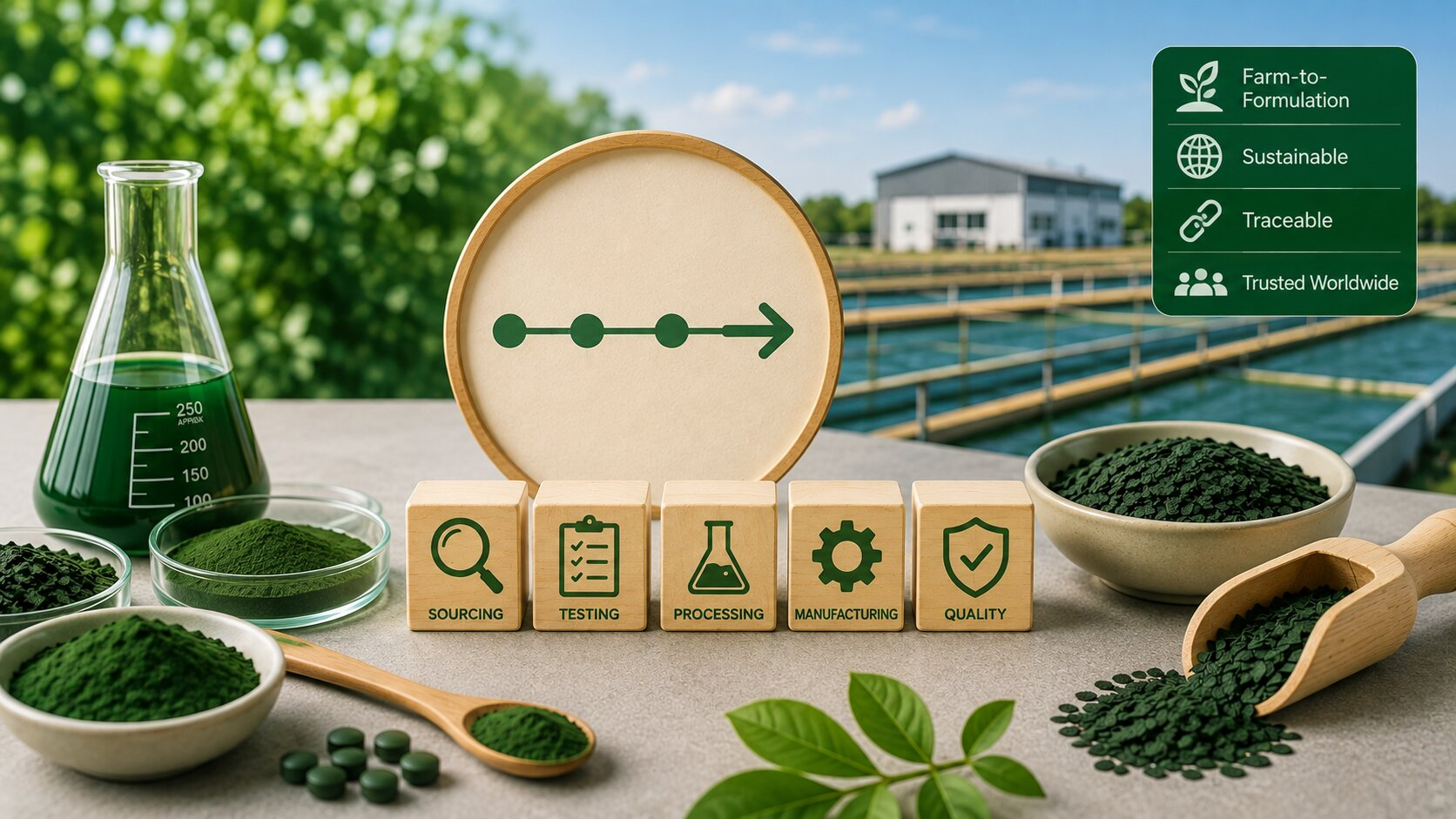
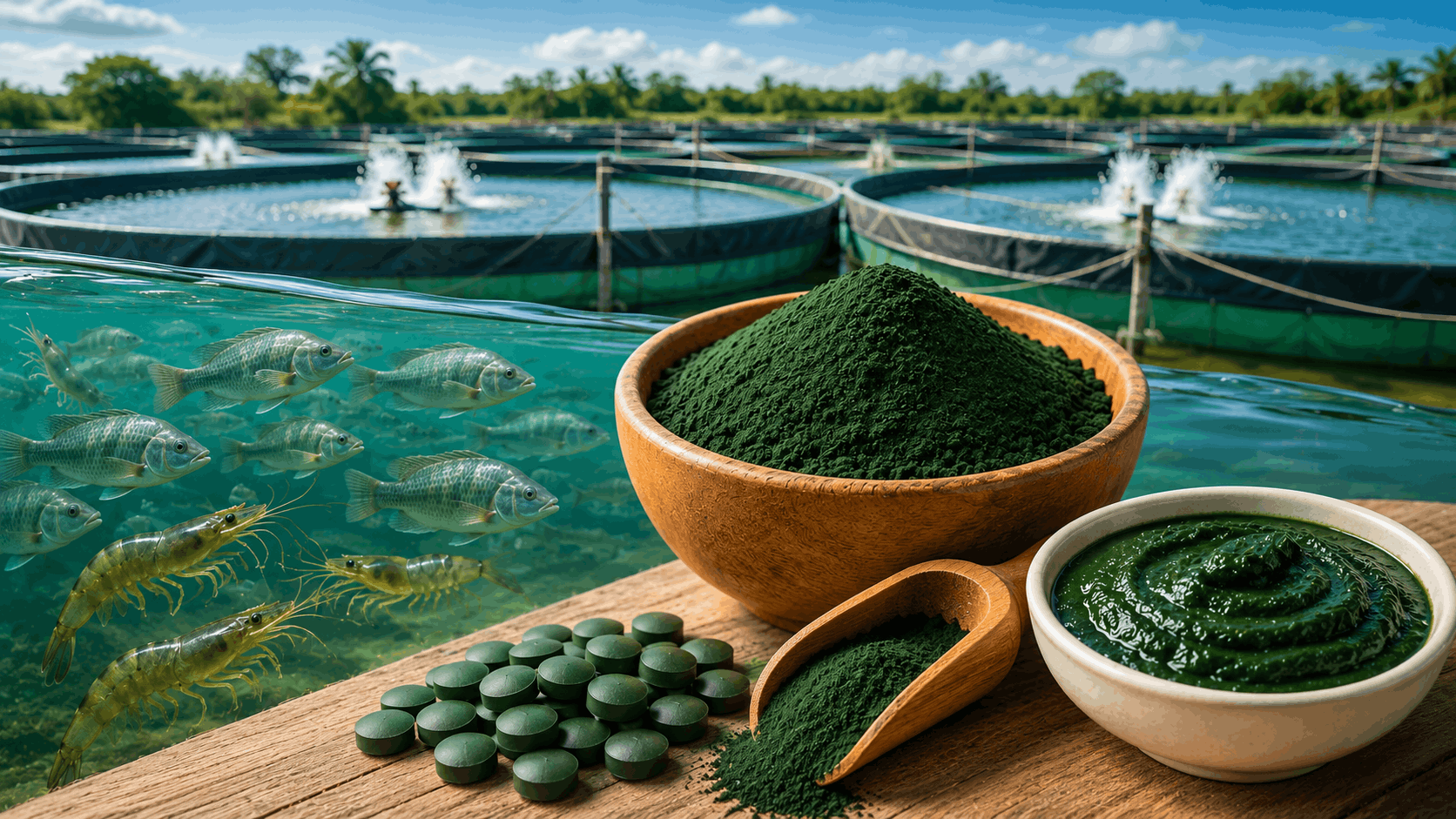
Choosing a spirulina aquaculture feed supplier India is not simply a matter of comparing price per kilogram. For fish farms, shrimp farms, hatcheries, feed manufacturers and aquaculture exporters, the real buying decision involves product consistency, safety documentation, traceability, nutritional specifications and the supplier’s ability to deliver the same quality over time.
Spirulina is increasingly positioned as a functional microalgae ingredient in aquaculture nutrition. But not every spirulina supplier is equipped to meet the requirements of commercial feed formulation. Before signing a supply contract, buyers should evaluate the product, documentation, manufacturing capability and commercial terms in detail.
This buyer’s checklist will help you ask the right questions before selecting a spirulina aquaculture feed supplier in India.
Quick Answer: What Should You Check Before Signing?
Before signing a spirulina supply agreement, ask for:
- Batch-wise Certificate of Analysis (CoA)
- Protein, moisture and nutritional specifications
- Heavy metal and microbiological test reports
- Traceability and batch identification
- Confirmation of the intended feed-grade application
- Consistent supply capacity and lead times
- Packaging and storage specifications
- Sample evaluation before commercial purchase
- Clear rejection and replacement terms
- Transparent pricing, MOQ and contract conditions
A reliable supplier should be able to provide documentation that helps your quality, procurement and formulation teams evaluate the ingredient—not simply provide a marketing specification sheet. Nutrialgo, for example, positions its B2B supply around batch-wise quality documentation, traceability and spirulina solutions for feed and aquaculture businesses.
1. Is the Spirulina Specifically Suitable for Aquaculture Feed?
The first question is fundamental:
What exactly are you buying—bulk spirulina biomass, a feed ingredient or a finished aquafeed supplement?
These are not automatically the same thing.
A spirulina powder may be sold for different applications, including food, nutraceuticals, cosmetics or animal nutrition. Your supply contract should clearly identify the intended use and agreed specifications for your aquaculture application.
Ask the supplier:
- Is this product supplied specifically for fish or shrimp feed applications?
- Can it be incorporated into an existing feed formulation?
- What form is supplied: powder, biomass, slurry or another format?
- What particle characteristics should our production team expect?
- What nutritional parameters are guaranteed within the agreed specification?
- Has the supplier supplied similar ingredients to aquaculture businesses?
Nutrialgo identifies aquaculture businesses and feed manufacturers as target B2B sectors and offers spirulina-based solutions for fish and shrimp feed applications.
Buyer checklist: Do not sign a contract based only on the word spirulina. Define the product specification and intended feed application in writing.
2. Can the Supplier Provide a Batch-Wise CoA?
A Certificate of Analysis (CoA) should be one of the first documents requested during supplier qualification.
The important phrase is batch-wise.
A generic laboratory report from an old production lot does not necessarily describe the material you will receive in future shipments. Your contract should clarify what testing documentation accompanies each batch or lot.
Depending on your agreed specification, ask for relevant data such as:
- Protein
- Moisture
- Ash or mineral content
- Other agreed nutritional parameters
- Heavy metal results
- Microbiological results
- Batch number
- Manufacturing or testing date
- Product identification
Nutrialgo’s published traceability guidance states that buyers can request batch-wise CoAs along with heavy metal, microbiological, moisture and protein analysis.
Contract question to ask:
“Will every commercial lot be supplied with documentation linked to its batch number?”
If the answer is unclear, resolve it before the purchase order becomes a long-term supply commitment.
3. What Safety and Contaminant Testing Is Included?
Spirulina is a biological raw material, which means quality control matters beyond its headline protein percentage.
For a commercial aquaculture feed ingredient, ask what parameters are tested and how frequently. Depending on your application and destination market, your quality team may require testing for contaminants and microbiological parameters.
Ask:
- Which heavy metals are included in the testing programme?
- What microbiological analyses are performed?
- Is testing conducted for each batch, at defined intervals or only on selected lots?
- Which laboratory performs the analysis?
- Can the supplier provide supporting reports when required?
- What happens if a batch fails the agreed specification?
Nutrialgo publishes heavy metal and microbiological analysis among the documents available for batch-level quality evaluation.
Important: Your contract should specify the exact acceptance criteria relevant to your feed formulation and market. Do not assume that a certificate or a general quality claim automatically covers every regulatory or customer requirement.
4. Can You Trace the Material Back to Its Production Batch?
Traceability is becoming increasingly important for B2B ingredient buyers.
If your feed mill receives a complaint, your customer requests documentation or your internal QA team identifies a formulation issue, you need to know exactly which incoming ingredient lot was used.
Ask your spirulina aquaculture feed supplier India:
- Is every shipment assigned a unique batch or lot number?
- Does the CoA match the shipment?
- Can the supplier identify production and dispatch records?
- How long are records retained?
- Can the supplier support a quality investigation if required?
- Is there a documented procedure for handling non-conforming material?
Nutrialgo describes traceability and batch-linked testing as part of its supply approach for spirulina ingredients.
For serious buyers, traceability should be a contractual requirement—not an afterthought.
5. What Nutritional Specification Are You Actually Contracting?
One of the biggest mistakes in ingredient procurement is buying based on a single number.
For spirulina, protein may be a key purchasing parameter, but it should not be the only one. Your nutritionist or formulation team should define the parameters that matter for the specific fish or shrimp species and the final feed formula.
Ask for:
- Guaranteed or target protein range
- Moisture specification
- Batch-to-batch tolerance
- Relevant mineral or ash parameters
- Agreed nutritional documentation
- Product consistency expectations
Nutrialgo publishes spirulina nutritional specifications covering protein and other composition parameters, while its feed-focused pages position spirulina as a functional ingredient for aquaculture applications.
Ask this before signing:
“What specification is guaranteed, and what variation is commercially acceptable?”
That distinction matters. A typical value on a brochure is not necessarily the same as a contractual guarantee.
6. Has the Product Been Evaluated in Your Feed System?
A laboratory specification does not replace an application trial.
Before committing to a large annual contract, request a representative sample and evaluate it in your own process.
For feed manufacturers, assess factors relevant to your operation, such as:
- Handling and flowability
- Mixing behaviour
- Compatibility with other ingredients
- Processing performance
- Stability during storage
- Consistency between sample and commercial material
For farms or aquaculture businesses using a supplementary product, evaluate it according to your own feeding programme and technical protocols.
Nutrialgo offers spirulina products for fish and shrimp feed applications and describes them as ingredients or supplements intended to complement aquaculture nutrition programmes.
Buyer rule: Never let a laboratory sample become the only basis for a long-term commercial agreement. Confirm how commercial lots will match the approved specification.
7. Can the Supplier Deliver Consistent Volumes?
A good sample is only useful if the supplier can maintain supply.
Before signing, discuss:
- Monthly and annual volume requirements
- MOQ
- Standard lead time
- Production planning
- Seasonal supply risks
- Packaging availability
- Emergency or additional-order capability
- Expected notice period for price or supply changes
This is especially important for feed manufacturers that cannot afford sudden ingredient substitutions.
Nutrialgo positions itself as a B2B spirulina manufacturer serving businesses requiring scalable supply, including animal feed and aquaculture sectors.
Ask directly:
“What supply volume can you commit to contractually, rather than simply quote today?”
The answer should be documented in the agreement.
8. What Packaging and Storage Conditions Apply?
Spirulina quality can be affected by poor storage and handling. Your procurement contract should therefore specify how the product will be packed, transported and stored.
Confirm:
- Packaging material
- Net weight per pack
- Batch identification on the package
- Storage conditions
- Shelf-life or retest period, where applicable
- Instructions for damaged packaging
- Conditions for accepting or rejecting shipments
Also ask whether the product should be protected from particular environmental conditions during warehouse storage.
Nutrialgo supplies spirulina ingredients in multiple B2B product formats and encourages buyers to work with defined quality and product documentation. (Nutrialgo)
9. What Happens If a Shipment Does Not Meet Specification?
This question belongs in every serious supply contract.
Define the procedure before there is a problem.
Your agreement should address:
- Sampling procedure
- Testing responsibility
- Acceptance and rejection criteria
- How quickly a complaint must be raised
- Whether a replacement, credit or other remedy applies
- Who bears return or disposal costs
- How disputes over laboratory results are resolved
A clear non-conformance clause protects both buyer and supplier.
Avoid vague wording such as “premium quality” or “best quality guaranteed.” Instead, link acceptance to measurable specifications and agreed documentation.
10. Does the Supplier Understand Your Actual Business Requirements?
The best supplier relationship is not just transactional. A supplier should understand whether you are:
- An aquafeed manufacturer
- A shrimp feed producer
- A fish farm
- A hatchery
- An exporter
- A distributor
- A company developing a new functional feed formulation
This matters because your documentation, packaging, supply volume and technical requirements may differ.
Nutrialgo’s B2B services include quality assurance, product development and manufacturing support, while its published customer focus includes animal feed manufacturers and aquaculture feed producers.
For buyers looking to source from a microalgae-focused partner, explore Nutrialgo’s spirulina solutions and B2B manufacturing and development services.
The Final Buyer’s Checklist Before You Sign
Before approving your spirulina aquaculture feed supplier India, make sure you can answer yes to the following:
- The exact product and intended aquaculture application are defined.
- Nutritional specifications are documented.
- Batch-wise CoA requirements are agreed.
- Heavy metal and microbiological documentation has been reviewed where required.
- Batch traceability is available.
- A representative sample has been evaluated.
- Commercial supply capacity matches your forecast.
- MOQ, pricing and lead times are clear.
- Packaging and storage requirements are documented.
- Acceptance and rejection procedures are written into the contract.
- The supplier can provide documentation relevant to your business and market requirements.
Final Thoughts
Finding a spirulina aquaculture feed supplier India should involve more than searching for the lowest price. The stronger procurement decision is based on specification control, batch documentation, traceability, supply reliability and a clear understanding of how the ingredient will fit into your aquaculture feed programme.
Before signing the contract, ask the difficult questions. Request the documents. Evaluate the sample. Define your acceptance criteria.
That approach helps turn spirulina procurement from a commodity purchase into a controlled ingredient-sourcing decision.
For businesses sourcing spirulina for fish, shrimp and broader aquaculture applications, Nutrialgo serves aquaculture businesses and provides contact options for bulk supply and technical enquiries.