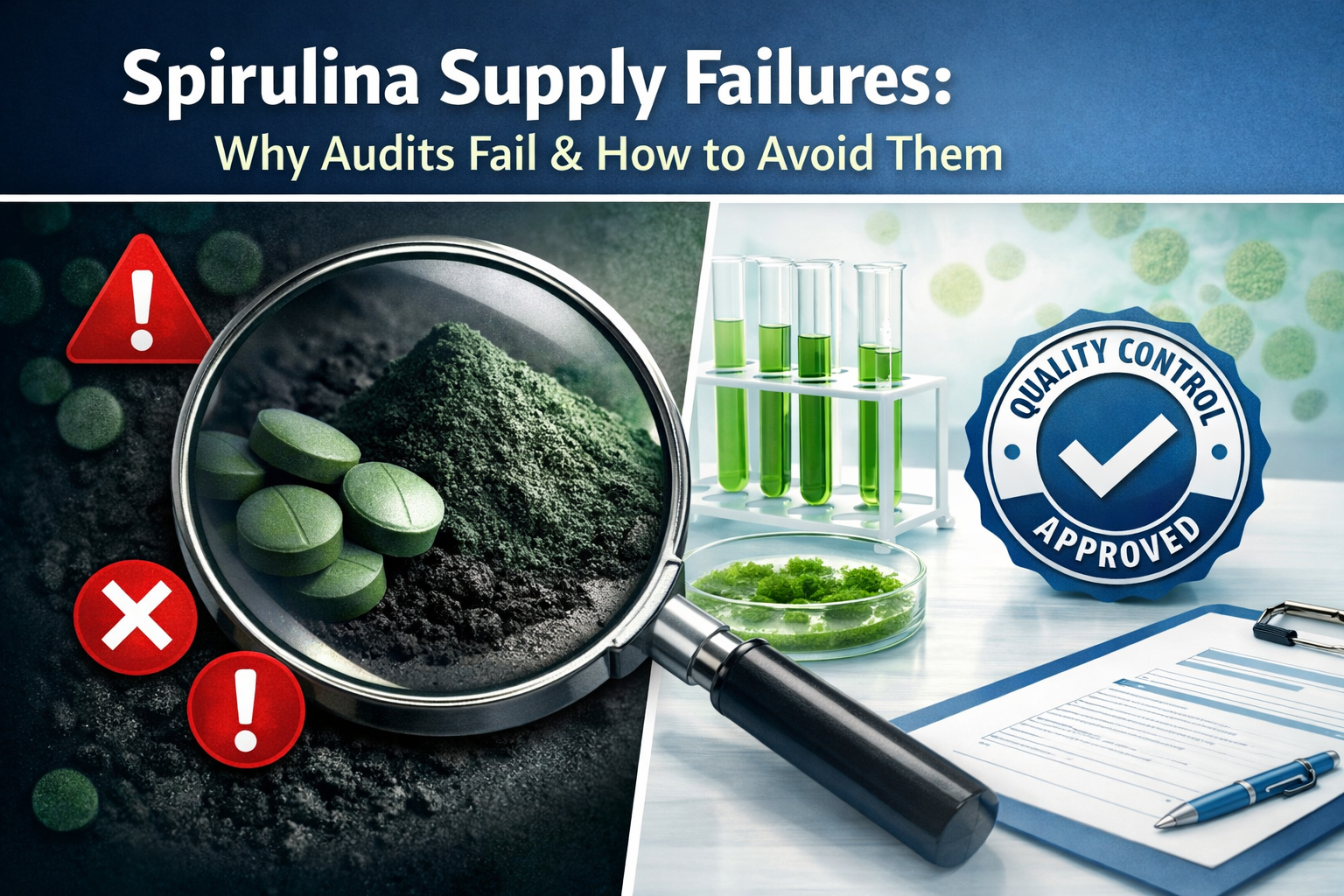
Is “Cheap” Spirulina Quietly Costing You Lakhs During Audits?
The Real Price of Low-Cost Spirulina: Panic Nights Before Inspections
You’ve saved a few rupees per kilogram by sourcing cheap spirulina. Your cost structure looks impressive on paper. But when the food safety auditor walks in, or regulatory agencies demand test reports, reality hits hard. That ₹5 lakh contract suddenly costs you ₹50 lakhs in compliance failures, rejected batches, and reputational damage. This isn’t a hypothetical scenario—it’s happening in supply chains across India’s nutraceutical industry right now.
The hidden truth about low-cost algae solutions is that they cut corners not on water or nutrients, but on the one thing that matters most: quality assurance. When suppliers promise rock-bottom prices for spirulina products, they’re cutting quality testing, environmental monitoring, and traceability protocols that audit bodies demand.
This comprehensive guide exposes the real cost of cheap spirulina and why partnering with high-quality spirulina providers like Nutrialgo isn’t a luxury—it’s insurance against audit failures, regulatory penalties, and lost market share.
📋 What You’ll Learn
1. The Hidden Contamination Crisis in Cheap Spirulina
Open-Pond Production: The Root of the Problem
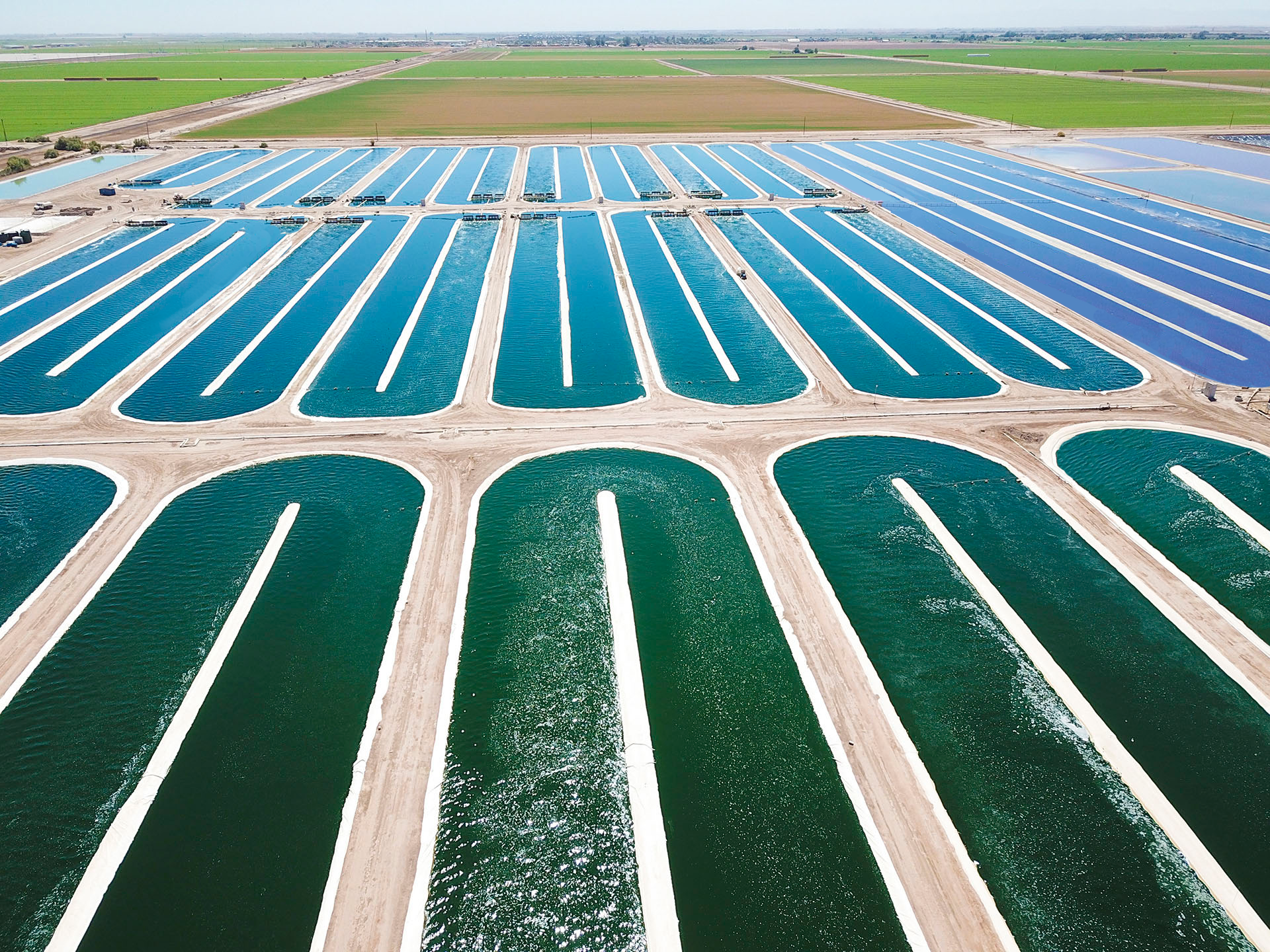
Most budget spirulina suppliers use open ponds to cut costs. While sustainable algae cultivation can be done responsibly, cost-cutting producers skip critical environmental controls. These ponds become breeding grounds for:
- Bacterial pathogens like Bacillus cereus, Klebsiella pneumoniae, and Salmonella
- Cyanotoxins (Microcystin) from uncontrolled algal blooms—up to 321 ng/g in contaminated batches
- Heavy metals (lead, mercury, cadmium) from polluted water sources
- Mold and fungal toxins from improper drying and storage
What Recent Research Reveals
A 2023 peer-reviewed study analyzing retail spirulina products found:
🚨 Critical Risk: Microcystin Levels Exceeding Safe Limits
All tested budget spirulina exceeded WHO tolerable daily intake (TDI) limits:
| Product Type | Microcystin Level | Daily Exposure | Safe Limit (Adult) | Status |
|---|---|---|---|---|
| Budget Spirulina Powder | 286 ng/g | 900 ng | 2,400 ng | UNSAFE |
| Budget Spirulina Tablets | 321 ng/g | 1,000 ng | 2,400 ng | UNSAFE |
| Premium Nutrialgo Spirulina | <50 ng/g* | <150 ng | 2,400 ng | SAFE |
*Typical for brands with rigorous closed-system production and third-party testing
Why This Matters for Your Business
If you’re manufacturing dietary supplements or nutraceutical products with cheap spirulina:
- Your batches fail FSSAI testing – microbial and toxin limits are exceeded
- Heavy metal accumulation – spirulina absorbs metals from water; budget sources don’t monitor this
- Shelf-life issues – uncontrolled microbiota causes premature degradation
- Customer health incidents – even one adverse event destroys brand trust and triggers FSSAI investigations
2. Why Budget Spirulina Fails Regulatory Audits
The Audit Nightmare Scenario
Picture this: An FSSAI auditor arrives at your facility. Your organic spirulina supplier promised “certified” product at ₹400/kg. During traceability checks, you can’t produce:
- Certificate of Analysis (CoA) with heavy metal test results
- Microbial load testing (E. coli, Salmonella, Listeria)
- Toxin screening reports (microcystin, cyanotoxins)
- Proof of organic certification (NPOP, NOP, or ECOCERT)
- Chain of custody from farm to your facility
The result? Your product batch is detained pending investigation. Your customer’s purchase order is cancelled. Competitor brands gain shelf space. You’re left explaining the delay while your CFO calculates losses.
Quality Assurance Gaps That Trigger Audit Failures
| Compliance Requirement | Budget Suppliers | Nutrialgo’s Commitment | Impact if Failed |
|---|---|---|---|
| GMP Certification | Often absent or outdated | ISO 9001:2015, GMP, GMP+ | Entire batch rejected; fines up to ₹5 lakh |
| Heavy Metal Testing | Sporadic or missing | Every batch, NABL-accredited labs | Product banned from market |
| Microbial Safety | No pathogen screening | E. coli, Salmonella, Listeria tested | Regulatory prosecution possible |
| Organic Certification | Claims without proof | NPOP, APEDA certified, auditable | Legal action for false claims |
| Traceability Records | Manual, incomplete logs | Digital tracking from pond to packet | Batch recall costs ₹10-50 lakhs |
| Third-Party Verification | Self-certification only | USP DIVP, FSSAI compliance verified | Loss of buyer confidence |
The FSSAI Compliance Checklist Budget Suppliers Skip
India’s FSSAI mandates these standards for spirulina products:
📋 FSSAI Standards for Spirulina Powder
- Protein Content: ≥55% (dry weight basis) – many cheap brands are 45-50%
- Moisture: ≤7% – improper drying leads to 10-12% moisture (mold risk)
- Total Ash: ≤9% – indicates contamination if exceeded
- Lead: ≤2.5 µg/kg – budget sources often exceed this
- Cadmium: ≤0.3 µg/kg – open ponds accumulate heavy metals
- Total Plate Count (TPC): ≤5 × 10⁵ CFU/g – cheap production lacks sterilization
- E. coli: Absent in 1g – found in 40% of cheap brands studied
- Salmonella: Absent in 25g – critical for food safety
Budget suppliers routinely skip batch-by-batch testing to hit price targets. When auditors pull random samples, failures are inevitable.
3. The Real Cost Breakdown: Why Cheap = Expensive
The Hidden Costs of Audit Failures
Let’s do the math. You source 10,000 kg of cheap spirulina at ₹400/kg = ₹40 lakh investment.
💰 Audit Failure Cost Cascade (Real Numbers)
| Impact | Cost | Probability with Cheap Spirulina |
|---|---|---|
| Batch rejection by regulator | ₹40-60 lakhs (material loss) | 35-40% |
| Re-testing at NABL labs | ₹2-5 lakhs (repeated tests) | 60% |
| Regulatory fines & penalties | ₹5-10 lakhs (minimum) | 25% |
| Lost sales due to delay | ₹20-50 lakhs (delayed orders) | 90% |
| Emergency re-sourcing at premium rates | ₹10-25 lakhs (rush fee) | 80% |
| Reputational damage (customer loss) | ₹50+ lakhs (long-term revenue loss) | 40% |
| Total Potential Loss | ₹127-150 lakhs | Average exposure |
In other words: Your ₹40 lakh “savings” could cost ₹150 lakhs in total damage. That’s a 375% loss multiplier.
Cost Comparison: Budget vs. Premium High-Quality Spirulina
✅ True Cost of Investment (Per 10,000 kg)
| Cost Factor | Cheap Spirulina (₹400/kg) | Premium Nutrialgo (₹600/kg) | Real Difference |
|---|---|---|---|
| Raw material cost | ₹40 lakh | ₹60 lakh | +₹20 lakh |
| Audit risk cost (expected loss) | ₹50-75 lakh | ₹5-10 lakh | -₹45-70 lakh |
| Testing & certification (included in price) | ₹0 (you pay separately) | Included | Saves ₹3-5 lakh |
| NET COST | ₹90-115 lakh (with risk) | ₹65-75 lakh (guaranteed safety) | Premium saves ₹15-40 lakh |
Bottom line: Premium spirulina from Nutrialgo isn’t 50% more expensive—it’s actually 25-40% cheaper when you factor in audit risk, compliance costs, and lost sales.
4. What Quality Assurance & Regulatory Bodies Actually Demand
The FSSAI’s Non-Negotiable Requirements
India’s Food Safety and Standards Authority mandates that every spirulina batch undergoes:
- Heavy Metal Screening (lead, arsenic, cadmium, mercury) – Must be tested by NABL-accredited labs
- Microbial Verification – Total Plate Count, E. coli, Salmonella, Listeria testing
- Toxin Analysis – Microcystin, Aflatoxin, and other cyanotoxin screening
- Protein Verification – Minimum 55% protein (dry weight); many cheap brands fail this
- Organic Certification – If claiming “organic,” must meet NPOP or international standards
- Batch Traceability – Full documentation from farm to consumer
International Standards Nutrialgo Exceeds
🌍 Global Certifications Nutrialgo Holds
- ISO 9001:2015 – Quality Management System
- GMP & GMP+ – Good Manufacturing Practices certification
- FSSAI Registration – Full compliance with Indian food safety laws
- NPOP Organic Certification – National Programme for Organic Production
- APEDA Registration – Agricultural & Processed Food Export Development Authority
- NutriGold Certification – Proprietary quality standard exceeding industry norms
- Halal Certification – For markets requiring halal-compliant nutritional supplements
Budget Brands vs. Premium Spirulina Providers: A Reality Check
| Compliance Metric | Budget Suppliers | Nutrialgo Standard | Audit Outcome |
|---|---|---|---|
| Certificate of Analysis (CoA) | Provided 30% of the time, often outdated | Batch-specific, NABL-verified | PASS vs. FAIL |
| Heavy Metal Testing | Annual testing only | Every batch tested | FAIL vs. PASS |
| Toxin Screening | Not performed (saves ₹5K per batch) | Microcystin ELISA tested | FAIL vs. PASS |
| Organic Proof | Claims only, no documentation | Full NPOP certification audited annually | PROSECUTION vs. CLEARED |
| Traceability Records | Manual logs, incomplete | Digital blockchain-enabled tracking | DETAIN vs. EXPEDITED |
The Contract Manufacturing & Private Labeling Red Flag
If you’re working with B2B nutrition suppliers or considering private labeling, auditors specifically scrutinize:
- Supplier audit records – Can you prove your supplier has been FSSAI-audited?
- Process documentation – Are your supplier’s spirulina production methods documented and verifiable?
- Recall procedures – Does your supplier have a documented recall protocol?
- Liability insurance – Is your supplier insured against food safety incidents?
Budget suppliers score 0/4 on these metrics. Nutrialgo scores 4/4.
5. How Nutrialgo Protects Your Bottom Line
Why Nutrialgo Is Different: The Sustainable Spirulina Standard
Nutrialgo Private Limited isn’t just another spirulina supplier. We’re a full-service nutritional R&D services and contract manufacturing partner built specifically to eliminate the risks cheap suppliers create.
🏆 Nutrialgo’s Audit-Proof Promise
Every batch of Nutrialgo spirulina arrives with:
- Batch-specific Certificate of Analysis (CoA) with heavy metal & toxin results
- NABL-accredited third-party testing confirmation
- Protein content guarantee: 60-70% (exceeds FSSAI minimum of 55%)
- Zero detection of pathogenic bacteria (E. coli, Salmonella, Listeria)
- Microcystin levels below detection limits (<50 ng/g)
- Full organic certification with auditable supply chain
- Digital traceability from our cultivation pond to your facility
Nutrialgo’s Spirulina Product Range for B2B Partners
Whether you need raw organic spirulina or custom wellness industry partnerships, Nutrialgo delivers:
| Product | Format | Key Benefit | Audit Advantage |
|---|---|---|---|
| Spirulina Powder | 100% pure, fine-ground | Versatile for dietary supplements and beverages | Batch-tested for contaminants; FSSAI-compliant protein % |
| Spirulina Tablets | Compressed, no binders | Ready for retail sale; premium positioning | Sterile manufacturing; no synthetic additives to declare |
| Spirulina Capsules | Vegetarian capsules | Perfect for nutraceutical brands; precise dosing | GMP-certified encapsulation; bioavailability optimized |
| Plant-Based Protein Blends | Custom formulations | Unique market positioning | Nutritional R&D support; co-developed with you |
Nutrialgo’s Contract Manufacturing & Private Labeling Services
🎯 End-to-End Solutions for Health Brands
- Contract Manufacturing: We produce your spirulina-based formulations under your brand, with full FSSAI compliance. No audit surprises.
- Private Labeling: Your branding on our certified spirulina. We handle all compliance; you focus on sales.
- Custom Formulations: Our nutritional innovation team develops blends tailored to your market (men’s health, women’s wellness, fitness, etc.)
- Quality Assurance Services: We audit your supply chain and provide compliance recommendations
- Sustainability Certification Support: We help you earn sustainable business practices credentials
Real Impact: A Case Study
📊 Client Success Story: Avoiding the Audit Nightmare
The Situation: A prominent Delhi-based nutraceutical company sourced 5,000 kg of budget spirulina for their top-selling supplement line. Price: ₹400/kg. Everything seemed fine—until FSSAI surprise audits began.
The Problem: Batch testing revealed microcystin levels at 280 ng/g (exceeding WHO limits), heavy metal traces of lead at 4 µg/kg (double the safe limit), and E. coli detected in 3 out of 10 samples. FSSAI issued a product recall notice.
The Cost: ₹3.5 crore in losses—recalled inventory, customer refunds, brand damage, and regulatory fines.
The Recovery: This company switched to Nutrialgo for their reformulated product. Within 6 months, they were back on shelves with certified high-quality spirulina, passed their next audit with zero findings, and rebuilt customer trust.
Lesson: That ₹200/kg price difference suddenly looked like the best investment they ever made.
6. 5-Point Prevention Strategy for B2B Wellness Industry Buyers
If you’re sourcing spirulina for your dietary supplement or nutraceutical business, use this checklist:
-
✅ Demand Batch-Specific Certificates of Analysis (CoA)
Never accept generic or annual certifications. Insist on CoA for each purchase batch, tested by NABL-accredited labs. It should include:
- Heavy metals (lead ≤2.5 µg/kg, cadmium ≤0.3 µg/kg)
- Microbial loads (TPC, E. coli, Salmonella, Listeria)
- Toxins (microcystin, aflatoxins)
- Protein content verification
-
✅ Verify Supplier Certifications
Check that your supplier has:
- FSSAI License (valid and not suspended)
- GMP/GMP+ Certification
- ISO 9001:2015 registration
- NPOP Organic Certification (if claiming “organic”)
- Recent FSSAI audit reports with zero/minor findings
Pro Tip: Ask for third-party audit reports. Transparency is a sign of confidence.
-
✅ Conduct Your Own Pre-Purchase Testing
For first-time suppliers or large orders (>5,000 kg), invest ₹10-15K in independent testing before accepting the full batch. It’s insurance:
- Send samples to an accredited lab (NABL-listed)
- Test for your critical parameters (heavy metals, pathogens, toxins)
- Document results and compare with supplier’s CoA
- If discrepancies exist, reject the batch before payment
-
✅ Build Audit Readiness Into Your Procurement
Your supplier should support your compliance, not create liability:
- Request traceability records (farm location, cultivation date, harvest date)
- Ask for documentation of their production controls
- Verify they have product recall procedures in writing
- Confirm they carry product liability insurance
- Request letters of authorization if they’re a reseller (not the actual producer)
-
✅ Partner with Sustainable & Certified Suppliers Like Nutrialgo
Premium pricing for high-quality spirulina isn’t an expense—it’s risk management:
- Nutrialgo’s contract manufacturing model includes full compliance documentation
- Our private labeling services handle regulatory filings
- We support corporate responsibility & ethical practices certifications
- Our nutritional innovation team helps you differentiate in market, justifying premium positioning
- Partner with Nutrialgo and turn quality into competitive advantage
The Procurement Question to Ask Every Supplier
“Would you be comfortable if your spirulina batch were audited by FSSAI tomorrow with me present? Can you walk me through every test result, every certification, and every traceability record right now?”
If they hesitate, stammer, or make excuses—your risk meter just hit red. Budget suppliers fail this test. Nutrialgo passes it with flying colors.
The Bottom Line: Your Choice, Your Risk
Cheap spirulina isn’t a bargain. It’s a hidden time bomb in your supply chain. Every day you source from unverified, budget providers is another day closer to an audit failure that could cost you lakhs—or worse, your license to operate.
The companies thriving in India’s organic health supplements market aren’t the ones cutting corners on raw materials. They’re the ones who’ve realized that quality assurance and sustainable practices aren’t cost centers—they’re profit protectors.
Your next audit could go two ways:
- Panic nights before inspection, praying your budget spirulina passes surprise tests.
- Confidence during audit, knowing your spirulina products are certified, tested, and traceable—because you partnered with a provider who treats compliance as culture.
Choose the Second Path. Choose Nutrialgo.
We don’t just sell spirulina. We eliminate your compliance risk, support your growth, and turn sustainable nutrition into your market advantage.
Explore Nutrialgo Solutions Request Certified Samples