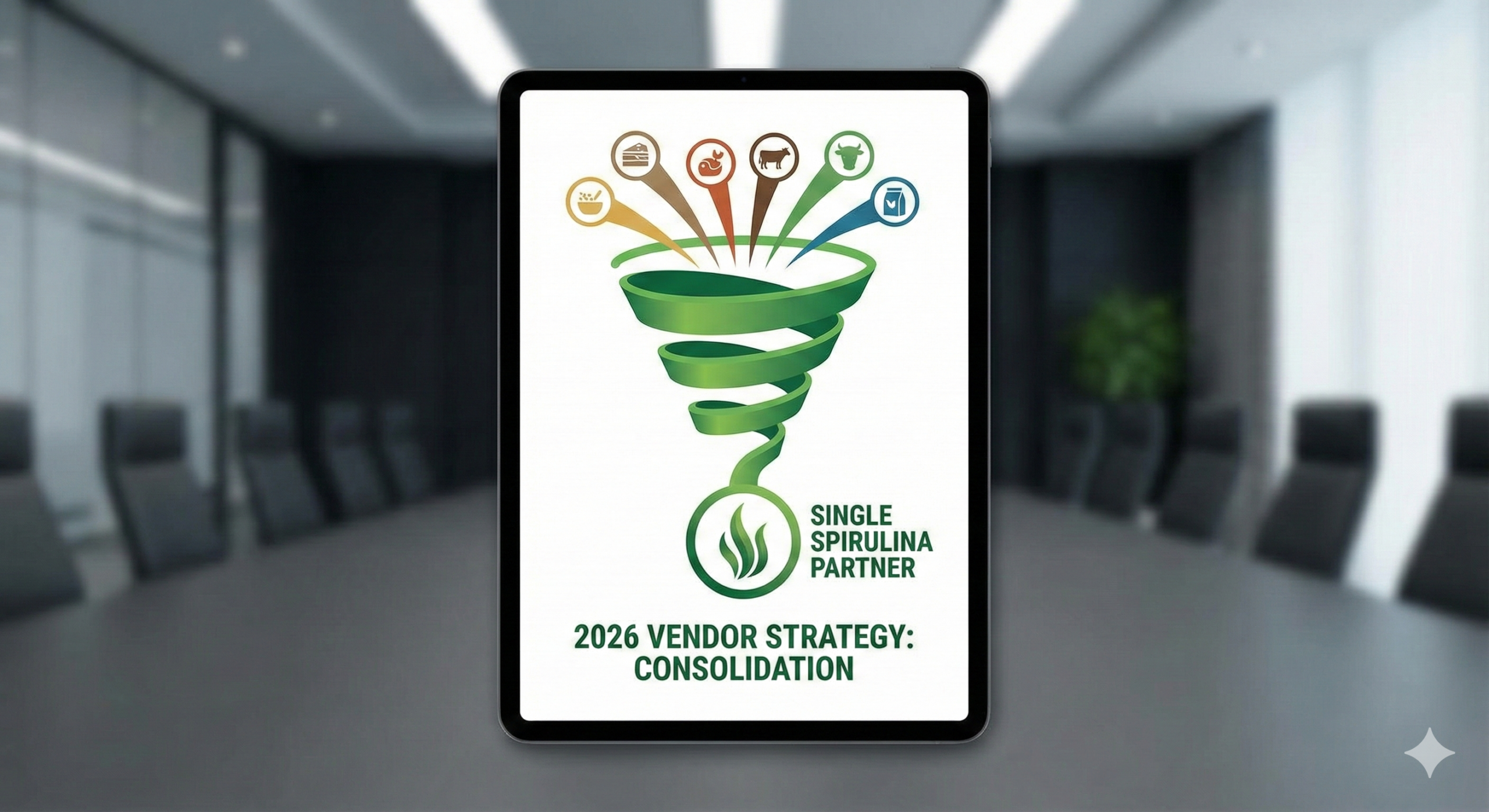
The nutrition industry is gradually undergoing a significant shift. Previously, companies dealt with a wide range of suppliers, but now they are moving toward fewer, more strategic collaborations based on trust, teamwork, and shared sustainability goals. As we approach 2026, key food and animal-feed businesses are realizing that partnering with one top-tier spirulina products supplier is more beneficial than managing many lower-quality ones. Below, we explore why these forward-thinking brands are consolidating their spirulina supply chains around a single partner.
The Case for Consolidation: Economics and Strategy
When companies examine their spirulina sourcing strategies, they discover that real cost savings come from more than just the price per unit.
Industry studies often show that consolidating suppliers can reduce administrative work by 30–40%, simplify contract management, and offer better volume discounts than what is available through multiple small suppliers. For example, combining supplier relationships can cut down on paperwork and overhead by as much as a third, while also offering more favorable bulk pricing. However, the biggest benefit comes from transforming procurement into a true partnership.
When you rely on one reliable algae solutions provider instead of several vendors, the entire relationship changes.
That supplier stops treating you as just another client and starts working on your success. They take the time to understand your research and development challenges, cost constraints, and business goals. Effectively, they become a partner focused on innovation with you, rather than simply selling you products.
This strategic shift brings several clear benefits:
- Volume pricing advantages: As your order volumes increase, you gain access to larger discounts.
- Streamlined logistics: Having a single point of contact ensures consistent quality and a reliable delivery schedule.
- Faster formulation cycles: Shared R&D efforts and customized blends develop more quickly with a dedicated partner.
- Early access to innovation: You get priority access to the supplier’s latest high-quality spirulina products and process improvements.
These gains aren’t just one-time benefits—they grow over time as the partnership strengthens.
By focusing all purchasing efforts on a single top-tier spirulina partner, brands turn procurement into a strategic investment, not just a cost-cutting measure.
Quality Standards and Traceability: The Non-Negotiable Foundation
By 2026, meeting quality standards will be the minimum requirement, not an extra benefit.
Major food and feed companies face strict guidelines related to organic certification, contamination limits, and full transparency across the supply chain. In fact, the new FSMA Rule 204 (effective January 2026) will require digital traceability for many high-risk foods within 24 hours. For companies using organic health supplements ingredients like spirulina, this isn’t just more paperwork—it’s a critical factor in selecting the right supplier.

Working with a single, fully certified spirulina partner that has strong quality systems means you don’t have to handle multiple audits separately.
If your supplier already meets standards like USDA Organic (NOP), APEDA, and ISO 22000, you automatically benefit from their compliance systems. This eliminates the need for separate audits of each vendor.
Top suppliers often use their nutritional R&D capabilities to offer traceability at the batch level and digital tracking (for instance, using QR codes that link to detailed data).
They also typically have third-party audits. Choosing such a reliable partner isn’t just about buying an ingredient—it’s about acquiring a built-in compliance and quality assurance system that protects your brand from recalls and delistings.
Partnering with one certified supplier also strengthens your position with major retailers.
Instead of dealing with different standards from multiple farms, you can highlight a single spirulina provider with strong certifications, documented cold-chain handling, and proven sustainability practices. Retailers value a unified, high-standard story over a fragmented one.
Sustainability and ESG: The Competitive Differentiator of 2026
Sustainability and ESG criteria are no longer optional—they are now required in procurement.
Leading food companies expect partners to demonstrate sustainable algae cultivation, reduced carbon footprints, and circular economy practices.
The issue with multiple suppliers is that each may report environmental data in different ways.
One might use a complete life-cycle assessment (LCA), another may provide limited metrics, and a third might not track emissions at all. Managing these varying reports is a complex administrative task and weakens your brand’s sustainability narrative.
By contrast, a single partner that invests in advanced cultivation methods (such as closed-loop photobioreactors, low-water systems, or nutrient recycling) allows you to present a consistent sustainability story.
Working with one algae solutions provider that uses cutting-edge practices creates a unified B2B nutrition sustainability narrative that appeals to both eco-conscious consumers and corporate buyers.
Many top spirulina suppliers report significantly lower emissions—around 50–76% less greenhouse gas (GHG) output compared to traditional protein sources like fishmeal, while using minimal freshwater and land.
They publish transparent life-cycle assessments and align with circular economy principles. This represents real progress, not just greenwashing, and provides a solid competitive edge.
This is especially important for animal feed producers.
Aquaculture and poultry companies are under pressure to replace fishmeal with sustainable alternatives. A dedicated spirulina partner who also offers specialized nutritional R&D services for aquaculture and animal feed means you have experts who understand the specific needs of different livestock categories. You’re not just purchasing bulk spirulina powder—you’re gaining access to a team ready to develop precise formulations for fish or poultry diets.
R&D Partnership Advantage: Innovation as Currency
Innovation in food and feed is happening faster than ever.
New product launches, clean-label conversions, and customized formulations can’t wait for lengthy procurement processes. Here is where consolidation becomes a competitive strategy, not just a cost-saving tactic. Top brands are narrowing their supplier base to access dedicated R&D support.
A leading spirulina partner with strong nutritional R&D capabilities does more than just deliver products—they help solve your problems.